*NEW* Search Our Team Reports! Type a word/phrase in the box below (hint: try "settlers').

6.27.2018

Welcome to Palestine

Our group split up for the first time on our second day in the West Bank. Scott and I decided to head back to Bil’in while the others stayed in Ramallah, catching up on work and emails. We had only been in Ramallah for a few hours, but we thought our presence was more valuable in the town than in the city. As the shared taxi pulled out of the Ramallah station, the hijab-clad woman sitting next to me wordlessly offered some of the pita she had just bought off the street. I smiled and mutely gestured that I was all set. “Shukran.”

After the short drive through the rocky hillside, we got dropped off at the local mosque. On the outer wall facing the street, a sign in Arabic was hung with a picture of Yasser Arafat on one side and Mahmoud Abbas on the other. After leaving our bags at the international house where we were staying, Scott and I took a walk through the town, retracing the tour we had taken the previous day with Iyad. On a nearby wall, someone had written in green and black graffiti, "Jerusalem is the capital of Palestine." As we climbed a small ridge, we turned and looked back when the adhan, the Islamic call to prayer, broke the silence. For the first time since being in the Muslim world, it sounded to me more like a sacred song, a hymn, than a recited prayer. The melodic incantation drifted up in the direction of the full moon, gleaming in the twilight.

Further along on our walk, we stopped near where the old wall had stood, looking out at the new one snaking through the hills. A few minutes passed, but we didn't talk much. What was there to say? As we joined up with road again, two young men walked passed us. “Welcome to Palestine,” the one in a hot-pink t-shirt called out to us. He took a few more paces and, without turning back around to face us, added as an afterthought, “Be careful.”
The road ended suddenly. Not more than 30 yards ahead, a 15-foot high concrete wall ringed with concertina wire stared back at us. The road here was scorched black from the demonstrations held at this spot every Friday afternoon to protest the settlement. I tried to imagine myself as a Palestinian. How would I cope with being forced to confront such a visible sign of my oppression every day? I didn’t know, and still don’t know, the answer. 

But then I peered into the settlement, picturing in my mind’s eye its residents deep in prayer. (Iyad had told us the day before that this was an Orthodox settlement. "They don't join the army," he informed us, twice. "Just praying.") My thoughts started to wander from one side of the border to the other. Over here, the Muslims bowed; up and down, shoulder to shoulder, touching their foreheads to the ground in unison. Over there, the Jews mechanically rocked back and forth, clutching their scrolls, mumbling under their breath in the language of the Bible.
There were no disturbances that night, no calls for us to come witness a raid. As I drifted off to sleep, I kept replaying a scene that had caught my attention during our evening stroll. From where we stood on the road, I knew that off in the distance, just out of sight, was the settlement. In the foreground, flapping idly in the breeze, was a Palestinian flag. It was torn in half.

West Bank Peace Team: Summer 2018, June 26


                                                  First Assignment: Bil’in
          After meeting in Jerusalem Sunday night and sightseeing in the Walled City Monday morning, we headed out to our first team assignment: witnessing to and perhaps mitigating Israeli invasions of the homes of resistance leaders which occur sporadically in the little village of Bil’in. The forced entrances are carried out well after midnight and our team had to be ready to arrive on the scene minutes after we were called. The first night there were no invasions, but our Palestinian hosts told us that they can occur twice a week or more.
          The village of Bil’in gets this “special attention” from the Israeli military because of their proud—and successful—history of resistance. Their weekly demonstrations, beginning in 2005, caused the Israelis to remove a portion of the Wall of Separation, which had divided the village in two since 2003, with 60% of their farmland on the other side of the wall. The protests, which had been organized by our host, Iyad Burnat  (who won the James Lawson Award for Nonviolent Resistance in 2015) involved hundreds of villagers, often joined by internationals, marching from the town center to the wall. In 2007, the Israeli Supreme Court decided in favor of the Palestinians, ruling that the construction of the separation barrier was illegal and finally, in 2011, the wall was taken down and re-constructed 500 meters back.

         On the recovered farmland, the people of Bil’in have put up greenhouses (donated by a Malyasian nonprofit) which allow them to raise tomatoes, cucumbers, okra, green beans, eggplants, and other vegetables organically. As we toured the rows and sampled the produce, Iyad explained that farming (they also grow grapes) is their most effective form of resistance today. “If the land is in use,” he said, “if people are working it,” the Israelis will be less likely to try to seize it again.”  The farmers tending the greenhouses raise the vegetables for profit, but also for free distribution to community members.
          We were all impressed by the greenhouse tour, but when we sat down later to talk with Iyad about the goals of the resistance movement, a somber tone prevailed. Sitting in a tent drinking thimblefuls of strong coffee which one of the farmers had prepared for us on his camp stove, we could look out past the Palestinian farmland, to the Israeli settlement just beyond it. The settlers’ homes, with their white walls shining brightly in the morning sun, included “swimming pools and beautiful gardens,” Iyad said, because the Israelis had taken over access to the local water, forcing the Palestinians to buy it back from them. There are now 70,000 settlers near Bil’in, “most of them,” he laughed ruefully, “from New York!” Subsidized by the Israeli government, they are free to travel throughout the country and abroad—unlike the Palestinians.  “A lot of those homes are empty,” he told us. 
         
When we asked Iyad what he envisioned for the future, he said nothing about a Palestinian state nor one state for Israel and Palestine with full membership for the Palestinians,  but only “a better life for my children.” After seeing the facts on the ground for ourselves, it seemed to us, too, that the Israeli drive to populate the West Bank with settlers (the goal is 250,000 in the settlement near Bil’in) will be inexorable and more and more of the Palestinians’ land will be taken, wall or no wall. At 44, Iyad has struggled against the Occupation his entire life; he has been jailed 18 times (the first time at 17 for two years) beaten, and now, he says, his children are being attacked. His three older sons have all been shot by the Israelis and one of them is currently in jail.
          Listening to him talk, I wondered if I would be as staunch as Iyad in his resistance to injustice. But there is clearly no turning back for him. He spoke passionately about the power of nonviolence: “nonviolence makes you strong,” he said. “When you confront the soldiers, you realize they are weaker.”He talked about teaching his children (who “have never been to the sea” and “have never seen Jerusalem”) “not to hate.”  “Love is stronger than hate,” he said. He didn’t share with us what sustains him in his work, but he alluded to it, “peace comes from the inside.” When he said that, for just a moment, I envied Iyad Burnat.


3.24.2018

Farming Gates

The Meta Peace Team Report for Saturday, November 11, 2017

This morning our team prepared with a Centering Practice of Yoga at the home where we are staying. We were invited to witness and record disruption of Settlers burning and chopping down olive trees at a Palestinian Family Farm.
Palestinian farmers working

On our way we needed to cross through a checkpoint used by the farmers to reach their farmland. When we arrived, the gates were closed, but the people working the checkpoint were present. At this Checkpoint, the Israeli Soldiers noticed that we were Americans and opened the checkpoint.
As a practice, our Team will use our judgment and we chose to stand in line behind Palestinian people, so we are able to witness how they are treated. In front of us, a Palestinian woman had her papers taken. Mother Bear asked the soldier questions and what was the process. Asking the Palestinian woman to leave without her papers puts her at great risk. Mother Bear then asked the soldier, how the woman would receive new papers. She asked several questions of the soldier. After several minutes, the soldier returned the papers to the woman, did not let her through to work with her family farm, and the crossing gates was closed.

Farming Gate just outside of Hebron

We were not able to proceed to the farm field to help the other farmer today as we were not able to get through the gate that leads to the farm land of the Palestinians.

I felt frustrated that so much precious time was lost and I wish that I had thought to videotape the behavior of the soldiers. The woman that was turned away has to make this trek to the gate and she reported that she is often turned away. I was hopeful that with the American's present, the Israeli’s would allow the farmers to get to their fields.

Our peace team

12.25.2015

Today I waited for a taxi to Ramalla where the Burin Road meets the main road. There was a man in his 30s who also wanted a taxi to Ramalla. But he was standing way back up the side road. I could not figure out what he was doing. I asked my hosts, who said he was afraid. 


The road to Ramalla is to the left. The man down by the telephone pole on the road to the right is waiting for the taxi to Ramalla


He was afraid of being run over by a settler's car. Once again, just last week a 15 year old boy was run over, only 50 meters from where I was waiting for the taxi.

Looking the other way the boy was run over near the telephone pole.

Unrelated to this incident in the first photo you can see the red sign.  This is one version of the signs which are on every road that enters an Area A.


These signs are part of spreading fear. Maybe it is not deliberate, but if you drove by one of these signs a dozen times each day it is bound to effect your thinking. These also help keep the Israelis from meeting Palestinians.

12.24.2015

Taking Land


24 Dec 2015/ Meta Peace Team, Scott/ Burin

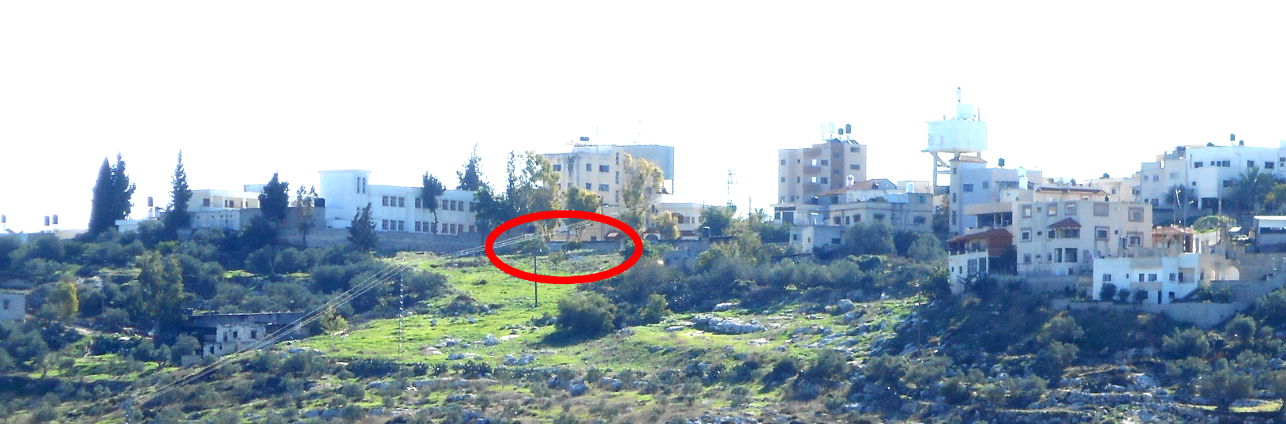
Colonial assault is visible in Burin.  Since last year I can see 3 new houses expanding the "out posts" which are illegal (under Israeli law) expansions of illegal (under international law) colonial settlements.  It is a process where a few radicals squat on land they do not own, build a house knowing that if they call the occupying army and say they are being threatened the army will arrest any Palestinian who dares to say it is their land.
on the hill in the middle of the picture you can see an outpost. The hill on the right has the highest house in Burin
 A closer view of the house on the right.  It is empty.  The settlers came down and attacked it so much the family abandoned it.

In this picture you can see the last house going out the road of Burin.  It too is empty, the settlers came down with torches and the family was afraid they would get burned up some time so the left their house.


The new houses on the hill impacted a friend of mine.  She has olives high in the hill. This year when she went up there were new houses next to her olives. The soldiers would let here in for 2 days to pick olives, but she is not well and even if she was she could not pick all her olives in 2 days.  Internationals who went up with her were forced by the occupying army to sit down by the gate into the olive orchard and watch.  They were not even allowed to accompany while she worked.  Mean while the woman and children from the new illegal houses yelled "bad things" at her.


Not Knowing What To Expect


24 Dec 2015/ Meta Peace Team, Scott/ Farun

People build a house on their land and then are notified by Israel that it will be demolished.  In some cases they just show up in the middle of the night and demolish it.  Or Israel builds a wall near the town (cutting hundreds of families off from their farms) and then decides that some houses are too close to the wall they built and destroys them.


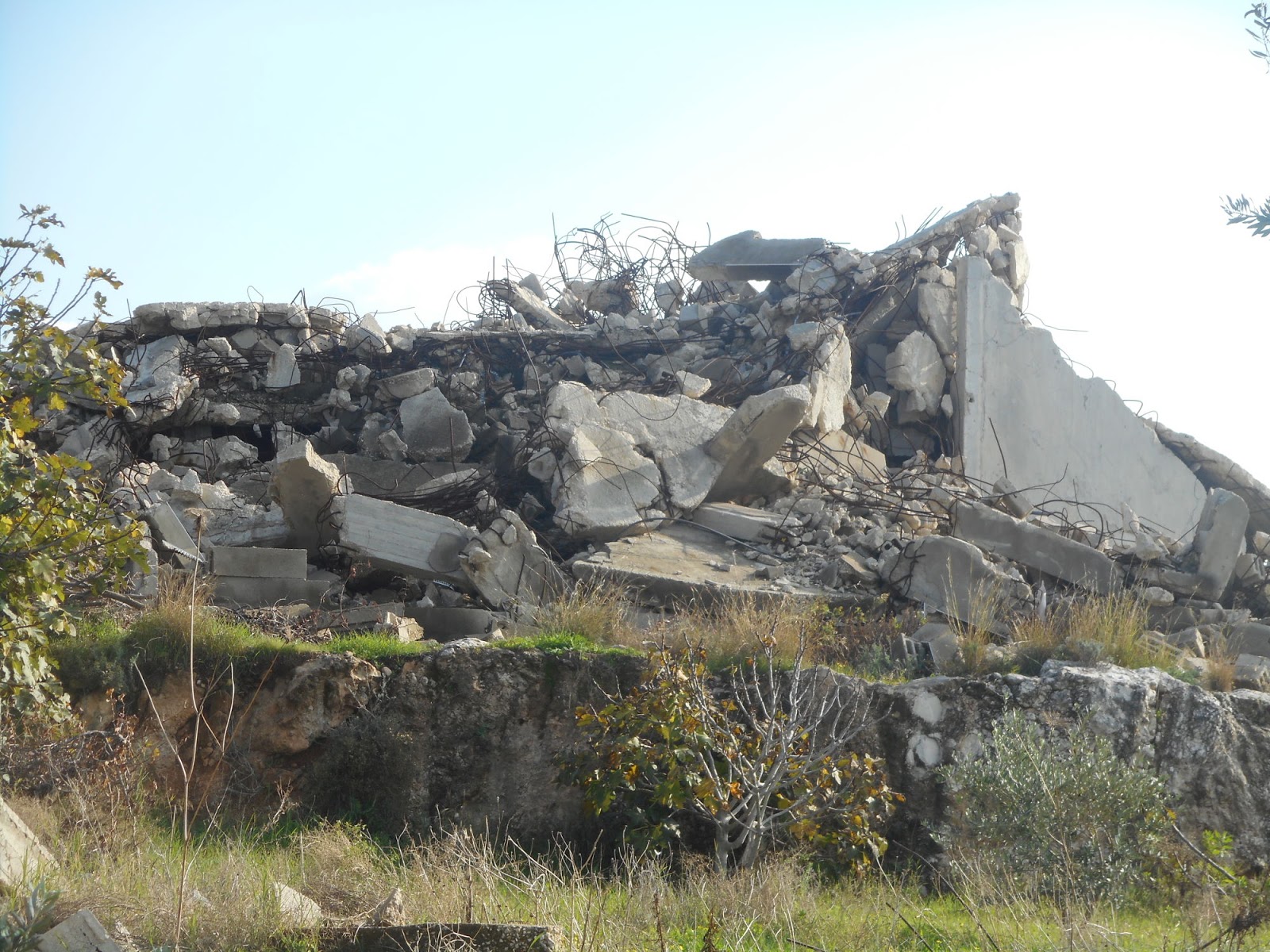
A few demolished homes

map of home demolition in Farun

I tried to collect the data in the village if Farun, I picked Farun not because the situation us especially bad, but because it was small and easy for me to get to.  It is just an example of life in the West Bank. I thought the village offices would have a complete list.  But I found that the Israeli occupiers do not bother with the legal government, they just go to a home and hand them a demolition order.  The legal government only finds out if the landowner happens ti tell them.

To the best if my knowledge none of these demolitions are collective punishment, some are deemed a security risk (too close t the wall Israel put where they wanted to), some seem to have needed a permit, some don't comply with rules Israel created.  As best I could find out there is no way to tell ahead of time if the house you are building will be demolished. Frequently it seems Israel waits until the house is finished before issuing a demolition order. 

Add caption
It is hard to imagine demolishing homes like these


The map has several layer each with a given color pin and a given category of misuse.  All layers may be turned on or off depending on what you want to look at.  In case you can't find the layer side panel:
          red - demolished
          light reddish - demolition orders which have not been carried out yet
          yellow - is denial of use, some times Israel tells a land owner if the stop using a buiding, and don't finish building it or repair it Israel will not demolish it. This saves Israel the bad press of demolitions.
          green - are events like people getting shot which have become part of the culture
          gray - are and marks, these are to help people orientate themselves if they choose to do a self guided tour of Farun.


link to map of house demolitions


12.18.2015

Keep The Gate Open

18 Dec 2015/ Meta Peace Team, Scott/ Deir al Ghusun

Farmers gather and demand their right to travel to their fields. The early morning sun rays fell farmers huddled around fires to stay warm as they waited for the Israeli army to arrive at the gate. This was a portion of the usual 200 farmers who pass through the Deir al Ghusun agricultural gate each morning to get to their fields which are on the Palestinian side of the Green line (1949 Armistice) but cut off from Palestine by the apartheid wall.

Yesterday word was sent out that Israel would shut this gate permanently requiring the farmers to go to another gate, adding another hour and a half each way to their daily travel. In addition it would require them to cross the green line and walk along an Israeli road next to a settlement.

farmers and tractors waite

Many gathered at the gate; farmers, officials including the Mayor, and internationals to protest this ruthless and needless action. After consultations and discussions the military agreed first to only allow old men through, but eventually to open the gate as usual.

This was a huge victory, a tribute to the farmers who refused to give in, the officials who added weight to the words if the farmers, and to the internationals who came to watch as the eyes of the world. This will not stop the humiliating searches, the unpredictable timing of daily gate openings, or the whim of individual guards to deny access randomly or tear up a permits. But it does allow the farmers to keep farming their land.

Palestinians "negotiate" with military commander  through the locked gate


In an unintended tribute to the international presence the military commander told the officials to tell the observers that everything had been solved and that there were no more problems. It is a reminder about the importance of people supporting or joining the international presence in Palestine.  

12.15.2015

Making it harder to farm their land

We arrived at the Agricultural Gate about 6:50 AM there were several farms waiting with their donkeys. The gate is supposed to open at 8:00AM, but it can be opened any time after 6:30AM. When it is opened the occupying soldiers process the farmers that are there then close gate and leave. One woman had arrived at 6 AM and got frustrated and left before they opened the gate.

A lonely farmer heads from the old gate to the new gate in the early morning

This gate, which is only for tractors and donkeys, is connected to the Ephraim check point. The Farun Ag Gate was closed 1 Dec 2015. With that gate it was 15 meters to one farmer's fields, now it is 3 kilometers. The apartheid wall cut Farun farmers off from 4000 dunnum of their farms.

Farmers gather in the early morning waiting for the gate to be opened


About 7:15AM four soldiers arrived to unlock the gate. At 7:28, after 2 people and one donkey had been processed the soldiers stopped the next person and donkey. They spent ½ hour on the radio and consulting among themselves before letting the second donkey through. They rejected one donkey and driver and about 6 workers were rejected (they may have been sent through the Ephraim gate). Five donkeys and 6 people were allowed to go to work.  Some days the soldiers don't even come.

7:36 the occupying soldiers locked the gate, checked it for security and walked back to the base.


The workers return to the gate in the afternoon. The gates is supposed to be opened to let them back through the wall at 4PM  

A donkey waiting at the gate
Curiously closing the Ag Gate and making the farmers go much farther to get to their fields also takes more time for the soldiers. The gate is now much farther from the base suggesting that the only reason for doing it is ti harass the farmers.

12.13.2015

Demolition of houses in Far'un

An example of the taking of land and penning in of communities can be found in the village of Far'un. The apartheid wall was a first step. As can be seen in the accompanying map at places the apartheid wall is placed 3 km inside the green line (1949 armistice line). A friend of ours had 400 acres confiscated when they built the wall.

Then the Israeli occupiers wanted check points so they could examine people and vehicles as they crossed from Palestine into Israel. The checkpoints are often elaborate with large buildings and extensive parking areas, all of which are carved out of Palestinian land. In the case of Far'un the occupiers were not satisfied with one check point, the wanted one that only processed trucks (At Tayba), one that only processed Palestinians (Ephraim), and one that only processed Israelis (Kafrait). See these on attached map


The names of the check points dominate the map At Tayba, Ephraim, Kafriat, the  location is marked with an X in a circle. The bold red line is the apatheid wall.  The dashed green line is the "green line."  About centered is the Village of Far'un, it is shown in a yellowish, brownish color.  The blue area is all Area C (contoled by Israel)

The apartheid wall around Far'un is mostly a fence, but it is an electified fence that has a road and also a buffer zone on both sides so it is about 50 meters wide of cleared and bulldozed land, Palestinain land. If you look at the attached google image you can see that the apartheid wall is the most prominent feature visible and that it is 2 to 3 times wider than the biggest road in the image. Looking at the map you can see they put the wall right next to the village on the south and west sides, which necessitated demolishing houses. Some people say “Israel wants the most geography with the least demography.” In other words they want the most land they can get without getting any Palestinians. What ever the rational one can see the wall cuts right next to the edge of the village, it separates the villagers from the land they own and which has fed their families for generations.


Besides building the apartheid wall they control the land near the wall. For example in the google image on the left side you can see a brown rectangle.  This was the village children's soccer field.  But the occupiers decided it was too close to the wall they had just built so they stopped the children from using it under threat that they would be shot.  In fact a 9 year old girl was shot (2006) on the road near the ball field, shot just for being there.  Adding insult to injury some occupying soldiers drove their jeeps into the ball field spinning their tires and turning tight corners rutting up the ball field. In the village some say the soldiers were drunk. It is hard to imagine how some kids playing ball could be a threat.  It is 100 meters to the area of the apartheid wall which is 50 meters wide and another 150 meters to the closest Israeli structure which is a fortified military base. Can the soldiers really be afraid of a child playing socker 300 meters away?


Houses and structures near the apartheid wall have been demolished and continue to be demolished.  As an example a family with 4 sons and one daughter worked for 11 years to build a house for the family, but when it was completed the occupiers demolished it (in 2014).  Not only did it put 7 people out of a home but the shock and grief caused the father to die.  The houses on both sides of this house were not demolished even though they were closer to the wall.  There is not some map or a way the residents can tell if their house will be allowed. They build on their land after years of planning, saving and work.  When the house is finished they are told it will be demolished. We do not know how many houses have been demolished, but we visited many that were rubble.  There are about 12 in the village that are currently scheduled for demolition.

It all seems so irrational.  In a large section of land on the southwest of the village (lower right of google image) no farming or activity of any kind is allowed, yet right close to the wall surrounded by this no use area a greenhouse and small field next to it is allowed (see photo).

These green houses are allowed.  The apartheid wall can be seen in the upper left. All the land behind the green house, to the right of the green house and in front is not allowed to be used even to pick olives.


At another spot a new farm has been scheduled to be demolished including the little new fuit trees.

On the north and east side of the village there is no apartheid wall, but here it is Area C, over which the occupiers claim complete control even though they acknowledge they do not own the land or the buildings. On the north side of the village a Christian neighborhood was demolished. You can see from the photo that there are houses, which are not schedued for demolition, on three sides of the demolished neighborhood. One half of the girl's school, also on the north of the village, is scheduled for demolition.  In the photo below you can see that it is a continuous wall but that part of it is older.  The old part is scheduled to be demolished.  Another photo shows a pinkish brown 3 story new building scheduled for demolition yet the buildings around it are not scheduled for demolition.

The Christian houses were in the area of the red circle.  The girls school is to the left of the red circle.


The left part of school is scheduled for demolition, the right part is not.


On the east of the village the same thing is happening, see the photos of three houses that are scheduled for demolition. They are no where near the apartheid wall, they seem to pose not imaginable threat to anything.  These are just new family houses being built as anyone would on the family land after years of planning, work, and pride.


We visited another category of buildings which are not scheduled to be demolished but only because the owners have agreed to stop construction, or repair, and to not use them. These do not appear as part of the numbers of demolitions, but still the work, investment and hope has been stolen from the family.

We visited a building which used to be home, but the family was told they had to move out or it would be demolished (2006).  In 2010 Israel gave them permission to convert it from a home to a wedding hall and as such it would not be demolished or at least not now.  This building is in the village and surrounded by other buildings which are not under orders to be demolished.

The Village of Far'un is just one example, there is nothing saying this village is to be eliminated yet is subjected to continued demolitions and denial of use of their land on all four sides.

12.11.2015

We are the eyes and the ears in the field. It is up to you to make a difference.

Having spent a month traveling around Palestine, meeting the people and witnessing the occupation, one may ask, “What can I do to make a difference?” It is difficult dealing with a belligerent occupying force such as Israel especially when they are financially backed by the United States, however, here are a few things that you can do to help bring peace and justice into the world.

One, share this message and websites (www.metapeaceteam.org & www.palsolidarity.org), tell a friend, learn more about the subject. It is important to not become indoctrinated with the Islamophobia that mainstream media promotes. Religion and the fear of terrorism are used to cloud much larger issues: Mainly that Israel is colonizing Palestine. Israel has made the Gaza Strip the largest open air prison in the world with nobody or nothing going in or coming out without permission, which is rarely given. 39% of Gaza's population is living in poverty (United Nations 2014) and 44% of Gaza is unemployed, 60% of the youth which is the worst rate in the world (World Bank 2014). Israel is committing genocide in Gaza just slow enough that the world will not notice.

16% of the West Bank lives in poverty (UN 2014) with 18% unemployed (UN 2014). Israel's demolition of Palestinian homes, forced evictions of Palestinian families and Israeli settler's stealing Palestinian homes and land have displaced many thousands of Palestinians. 44% of Palestinians are refugees and 50% of those are below the age of 18 (UN 2014). Israel is ethnic cleansing the West Bank just slow enough that the world will not notice.

The second thing that can be done is to boycott Israeli products and to divest from companies that do support Israel and their illegal occupation like Volvo, Caterpillar, Hewlett Packard, Eden Springs, Ahava, Teva and Sodastream. Anything made in Israel (Bar code starting with 729) or made by Israeli owned companies supports the holocaust in Palestine. Follow this link to find a list of companies to avoid purchasing their products (www.bdsmovement.net). Share this list with your friends. One person I spoke with said when they find Israel products, they purchase them and then bring them back for a refund so the product will not be sold again and be shipped back.

Third, contact your US senators and representatives and tell them you do not support the US funding of Israel. Israel's actions are considered war crimes, in violation of international law. The UN has labeled Israel as a belligerent occupying nation. Opposing UN resolutions Israel continue to steal Palestinian land, indiscriminately murder Palestinians, illegally detain and arrest Palestinians, sometimes without charge for as long as they want, allow Israeli settlers to terrorize Palestinians, steal homes and land and murder Palestinians without repercussions, restrict Palestinians the right to travel in their own country, terrorize Palestinian schools and universities, steal natural resources like water and sell them back to the Palestinians, demolish Palestinian homes displacing thousands of families, building an “apartheid wall” separating people from their farms and land and harassing Palestinians olive farmers trying to pick their crops. Israeli's also perform collective punishment against Palestinians by closing roads and businesses for almost anything that happens like when a child throws a stone or when Israeli defense forces shoots a Palestinian or demolishing homes of children that are arrested.


The most important thing is that you do something. Creating peace and justice in the world is not a spectator sport. As the infamous US president George Bush once said, “You're either with us, or against us.”
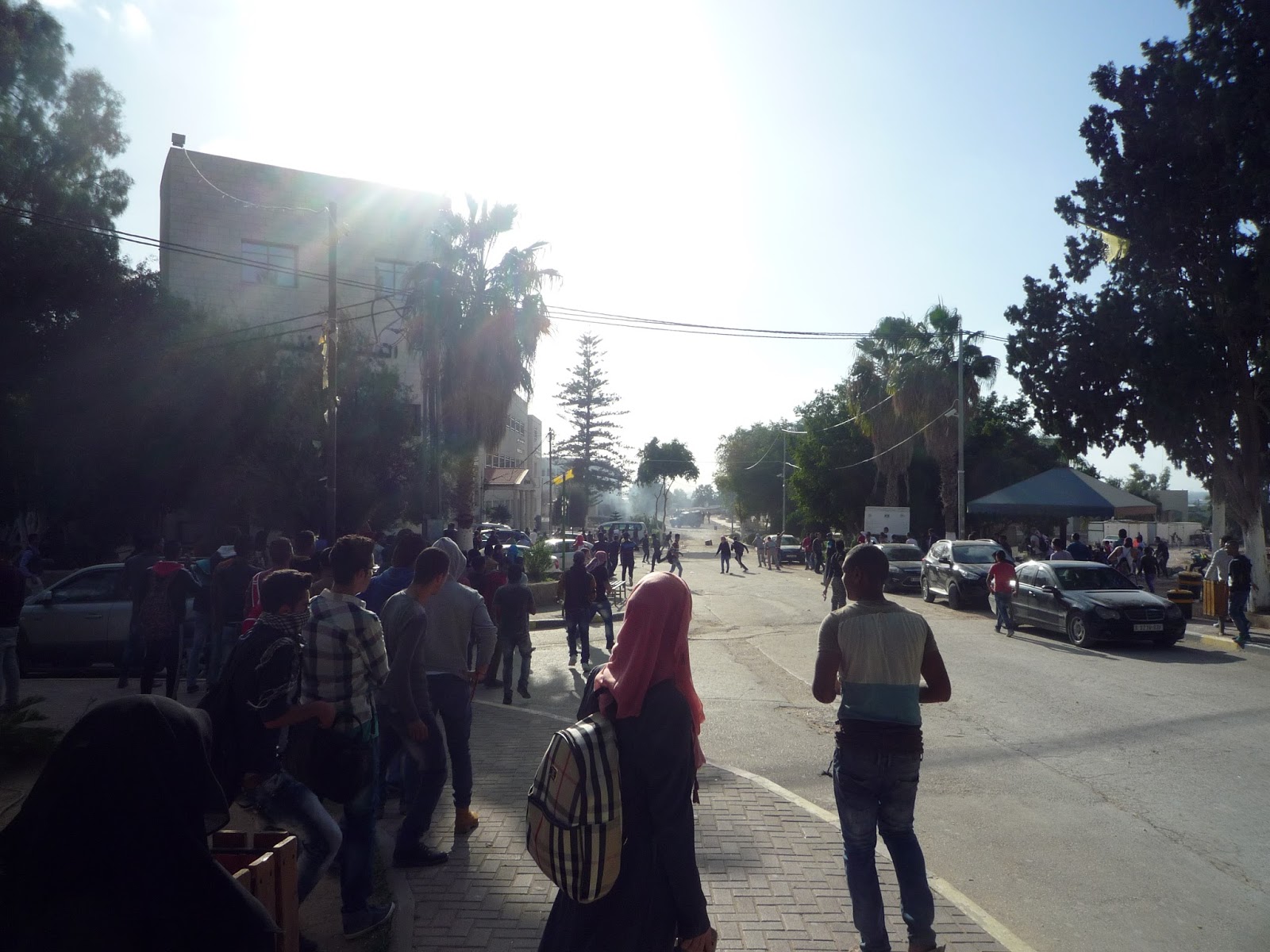
Occupying Israeli soldiers storm Palestine Tech University, shooting 7 unarmed students

Occupying Israeli army shoots ambulance

Occupying Israeli shoot bullets and tear gas into PTU library