*NEW* Search Our Team Reports! Type a word/phrase in the box below (hint: try "settlers').

12.13.2014

9 Dec 2014 Olive trees killed by settlers


We drove north east of Aqraba along many little dirt roads and arrived at the edge of a valley.

On the way in we had passed many fields, flat land with stone walls around them, but there are no crops or plowed land. We are told that people want to farm their land but are afraid to because the settlers come and stay with guns - even though they own no land here. We are told the settlers know they can not quite take this land yet but they come to scare the owners away from using their own land and that is the first step.

We arrive a a small flat spot to park the car on the edge of a beautiful narrow valley in the distance we can see the Jordon Valley stretching over to the high land of Jordon. Here we find young olive trees broken off and/or uprooted. Some still had the labels around their trunks from the nursery. About 50 trees in total had been killed but it was hard to count them because the terrain is steep and the trees were not planted in nice rows but are planted a tree or two here or there where every there is room for a small terrace. Who ever killed these trees had to work at it. The elevation change from the parking area to the lowest trees must have been 200-300 feet and the trees are hard to find scattered around in no predictable pattern, where ever there is a little soil.


There is a settler who drives over to here all most daily and sits for an hour or two in the morning and returns for an hour or two in the afternoon. While he does not stop Majed who he knows owns this land he is being sure no one else comes, especially to the flatter more desirable fields. Since the settler is the only one who is ever around Majed asked him why he would do such a thing as kill his trees. The settler told him that he did not do it is was one of Majed´s neighbors who did it. Thinking back over the empty fields we traveled through to get here it is hard to imagine who this imaginary neighbor could be or where he would have come from.

Majed´s father and grandfather lived here on this land year around. We see the foundations and remnants of several cottages. They had everything they needed right here. There is water in the spring down in the valley, they grazed cows and sheep and they grew wheat, fruit and vegetables. They had no need to go to Aqraba. They stayed on the farm in this beautiful little valley. But now the family is not allowed to live here.

We see a few tired almond trees and it is explained that they used to grow almonds. This area used to grow 14 tons of almonds a year. But almonds take a lot of care and now since the settlers harass and threaten the farmers they can not give the almonds the care they need so they have mostly died. Now, those who can plant olives. Olives can survive without being fussed over.
This amazingly small ditch catchs the rain water and funnels it into the cisteren

captured rain water saved for irrigation

This land was all part of the life in Aqraba. They all had farms here and most people in Aqraba live out here for 4 months in the spring. Some, like the Banijamas, stayed all year. As we walk around Sammi collects leaves to roll warak dawali, a mustard for salads and other greens. They say the people in Aqraba will be surprised because the plants in this protected valley is a month ahead of Aqraba.


Across the stream on the opposite hill we can see a cinder block house, the only house around. This was another family that lived out here year around. In 1967 when the owner died his son moved in. But the Army would not let him stay so the house and land have been vacant since then.

We hear that even shepherds can not use this land. Some settlers surrounded a shepherd armed with stones and axes, they hit him many times and tied his hands – they were going to kill him. Word got to Aqraba and the villagers ran to his rescue and saved him. Since then no one has been allowed to enter the area.
Track that goes around hill to next valley where his uncle owns, but is not even allowed to go to it.

Majeds uncle owns land in the next little valley, like this one, with a spring, but bigger and nicer. We can see a track on the hill side on the other side of the stream that leads around to his family farm. Last spring 15-20 people went over to his Uncles place. When they came back there was a group of settlers standing in the parking area shoulder to shoulder blocking the way back to their cars. They asked Why are you here¨ They were looking for a confrontation. ¨We just visit our land.¨ The settlers called the army and said the Palestinians been over yelling and throwing stones at settlers. The army came with guns and believed the settlers. They tried to arrest and take two people of our children, but we were able to keep that from happening. Before the soldiers left they said next time don't come back here.

We heard that in 1969 a helicopter flew over this whole area spraying it all with herbicides. These fields were all in wheat but it all died. After killing the crops they declared much of it a closed military area and no one is allowed to be in it.

I heard Majed yelling a hello at someone across the valley and talking with them, but I could not see anyone. When I moved to where I could see him I realized he was just talking on his cell phone.

At one point I could see a half dozen people on the far hill. When I pointed them out no one said anything but there was a new tension in our group and people moved visibly faster. But when I pointed it out to Majed he said they were Palestinians on the path to another valley. Then everyone relaxed. But it pointed out to me the apprehension everyone lives under.


piled rocks tell shepherds that there are crops here and not to grazz anmilals

Flowers bloom in any crak in the rocks

Majeds family has used this tree for a hundred years, resting, eating, having coffee under it

looking down the valley. the far hills are in jordon

looking up the valley

Land that was all farmed by Aqraba residents. Now they cant use it.

the road home

The road home


12.11.2014

5 Dec 2014 Journalist shot Kufr Qaddum


5 Dec Kufr Qaddum

There has been a demonstration here in Kufr Qaddum every week for 5 years calling for their road to Nablus be reopened. After settlers built an illegal settlement on it the Israeli government closed the road. For Kufr Qaddum residents this means the trip to town, Nablus, and the hospital has gone from 10 minutes to 45 minutes. Residents tell me that people have died because of the longer ambulance trip.

We arrived early and were able to see the soldiers park their vehicle 150 meters farther away from the village than they were last week. They moved froward, dodging from behind one barricade to another. I sat on some steps right next to the road in a high visibility vest. As the soldiers moved forward everyone else moved back. I made believe I was filming with my cellphone which had no charge. After a while the soldiers moved up to where I was. Just as I was wondering whether they were going to pass me, leaving me on the opposite side of them from my friends. One of the soldiers yelled at me and signaled for me to move up the road toward the few gathered demonstrators and observers. I was not at risk from stones because there were none being thrown. I walked slowly and deliberately right down the middle of the street. If they had wanted to target an international here was the prefect target. Besides the usual M4s I saw a Ruger 10/22 and an M32 (the 40 mm tear gas 6 shooter). At this point I left the demonstration area and waited the half hour for the demonstration to begin.

When we returned the soldiers were much further forward and had an armored front end loader. As the front of end loader pushed dirt to the side of the road and picked up some tires the soldiers gave it cover from some imagined enemy. Apparently they were moving dirt to facilitate using the Skunk Water truck which would soon arrive. In the first 15 minutes of the demonstration the occupying army shot a journalist in the leg with a Ruger 10/22 (a 22 cal. LR with and expanding bullet). At this point the journalist was just 5 meters behind me. It seems ridiculous to have to say this but the journalist was not and had not been throwing any stones. At the time he was shot he was standing behind a video camera on a tripod and there was no one in line with him throwing stones. of him. The shot was from just 60 meters away and the solder must have had at least the standard 4X telescopic sight. It is hard to imagine how this could have been an accident.

While it clearly was not a mistaken shot and they chose to shoot an unarmed, non-aggressive journalist, it is important to remember that in the big picture this weapon should not have been being used at all. This weapon, the Ruger 10/22, was conceived of as a weapon to be used as the last last and final resort before the use of standard military NATO ammunition aimed to kill. This is a weapon that if shot at the legs, probably will not kill, but clearly will do so much damage that the person hit will have to be evacuated and spend several weeks in the hospital. It was billed as a last resort to remove particularly dangerous people from a riot at lower risk of killing them. After several people were killed the Judge Advocate General tested the weapon and restricted it to only be used as a last resort before shooting to kill. Now in this case no other crowd control devises or weapons had been used. I saw that they had tear gas available and there is a long list of less lethal weapons including rubber bullets, rubber coated steel bullets, bean bag projectiles, ballistic batons, etc that they should have been used first. Further more the soldiers were just plain not at risk.

Ten minutes after that they moved the skunk water truck up. This truck has a high pressure nozzle on top that sprays a stream of really disgusting smelling liquid – it really smells awful and is very hard to wash off. Most of the rest of the demonstration was soldiers shifting positions behind the skunk water truck with the skunk truck periodically making dashes forward to try to spray the demonstrators as they tried to run away. But each time it did this it came under a hail of training rocks. I could not see any damage, but it sounded as though it would have been all dents. After about 2 hours the soldiers started to with draw. As they with drew the threw the first two 2 gas grenades.

New Askar Camp

27 Nov

We visited the New Asker refugee camp. The Asker Refugee camp dates back to the 1948 Palestinian displacement. In 1965 it had to expand to the New Askar Refugee camp which now has a population of 10,000 and is also under UNRW.

Like the near by Balatata Camp New Asker has a cultural center which tries to support the work of the over worked schools, two for the camp, and provide cultural and other needed services.


Askar Camp Cultural Center Computer room

Class room  the loom is for teaching weaving with handcapped stundents
with the schools stressed the cultural center works to close the gap


During the Intafata thsi street was deadly sniper from the settlement would shoot people who walked on this street

clouds role up the hill to the north of New Askar

A French group stood up here in horror as down below at the intersection occupation soldiers opened up and shot at a group of Palestinian children


The next three frams are a mural from left to right


This house will be an example of collective punishment. Because of what the son is accused of doing the parents house will be demolished (the Israeli engineers have all ready come out to plan the demolistion.) In addition the brothers house is on top so his house will be demolished too. It is one of the newer houses in New Askar. The streets are very narrow making it hard to get a picture of the house. And increasing the likely hood that many surrounding houses will be demolished.

looking north west. again the upper part of the hill side has been taken as an Area C around an illegal settlement. Which also took land from the legal owners


12.02.2014

Balata Refugee Camp


The fogg blowing in from the north


At Balata Refugee Camp, a UNAR refugee camps estblished oafter the displacment of Palestinians in 1948, we visited the Jafa cultural center.

They serve the camp which is 28,000 residents squeezed into 1 square KM. Since Oslo things have been much worse. Before Oslo residents received regular packets of food and clothes, there was better health care and medicine. Now all those tings are in short supply. there is now 1 clinic with 2 doctor serving the whole camp. A worker at the center took his mother to the doctor and time the visit – it was 49 second long – but what can a doctor due when there is a great long line of people waiting to be treated.

There are 2 boys schools and 2 girls schools through 9th grade but class sizes are 45 to 50 students. There is one social worker for 800 students. As a school administrator said the schools are no longer suitable for study, it is all shouting and disruption. It is a bad situation, these4 are families that lost everything, there is no work, the kids are bored. Many of the lightly older generation are highly educated but still have no work which makes it hard to motivate they younger generation to even complete their school

The cultural center offers many programs to try to support the camp:
a separate social worker unit
a chorus
an orchestra
music lessons
theater
support for the schools
a scout program has 100 scouts 50 female, 50 males

As we stood on top of the cultural center over looking the camp and school were told that the houses (3 floors or so) had on average 30 -40 people living in them. And looked up at the settlement guard tower we were told that during the intifada they did not use the roof space because several people had been shot stand where we were.

Looking south from cultural cneter roof over one of Balata Camp school

looking north

looking east these houses average 30-40 people

looking SE


Looking west toward settlement  and hearing that several people were shot right where we were

Truck tire treads make good speed bumps

a mural on the wall
a woodburing representng the old passing on the stories to the young, the old man has his head resting on the land


soldiers in Huwarra


1 Dec 2014

The occupying Army showed up in Huwarra. Nothing unusual had been happening and nothing unusual happened while the occupying army was here. It started about 2:30, and shortly there were groups of 2 or 3 soldiers who had forced their way on to tops of 9 houses and looked down their rifles at the street. The main street had squads of 2 or three soldiers positioned on both sides of the streets close enough that any squad could see the next squad on either side of them and often closer than that. Early on we heard there was a temporary check point set up on south end of town that was only checking spoiratic cars and was not stopping any of the yellow license plates of settlers. One of the soldiers in the center of town signaled a car over and check their papers, but this seemed more boredom than anything else, we did not see him check any other car and we counted as 50 cars went by. During this time he wandered around and paid no particular attention to the passing cars. All of this intense military coverage was concentrated in ¼ to 1/8 or the length of the main street in town. In fact a corner a little farther south on the main street that normally has a squad posted at it did not have anyone. It started about 2:30 PM and the soldiers were all gone by 5:20 PM. Other than forcing their way into peoples houses so they could stand on the roof nothing really happened. There was no apparent reason or objective for all this military activity. Unless it was just to humiliate people.


closing Huwarra 24 Nov

                                                                                                                                                                            Another closure of Huwarra.

For some unknown reason the occupying army decided to close Huwarra again. They started from the north end of town and squads of soldiers walked down both sides of the road telling each shop to close and shutter their doors. A squad would come by a shop and then shortly after another squad would come by. We could follow their progress through town by where we heard the percussion grenades going off. We counted 12 of them by the time they reached the end of town.

We know, at other times, they have thrown percussion grenades into shops they thought weren't closing fast enough.  We also saw a bunch of boys running away from where were heard grenades and assume they were also throwing grenades at groups who were not getting off the street.

One grenade was thrown into a shop sign after the shop was already closed and shuttered. It not only damaging the sign, but also the damaged the lighting fixture in the sign and even the back of the sign.  It kind of feels like some of the grenades are thrown just because the soldiers enjoy throwing them. 


12.01.2014


A few fireworks went off afternoon on 23 Nov in Huwarra. A little while later all kinds of occupation forces and vehicles showed up. Apparently a settler had reported he heard gun fire, or was shot at, as they passed through Huwarra. Of course the opinion of a passing settler is taken over the opinion of a dozen Palestinians who were present to see the burst of the fireworks.

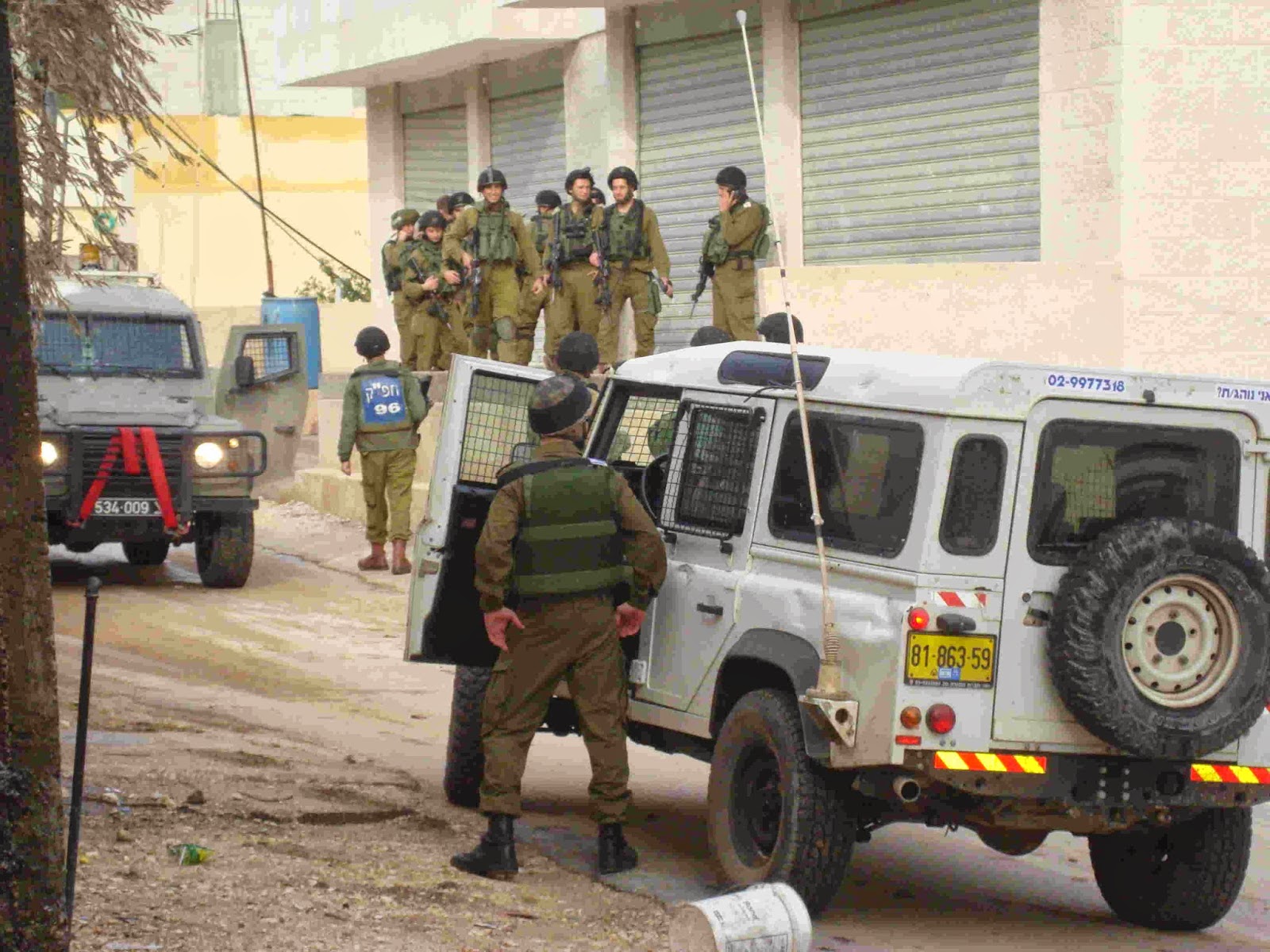
We stood where we could watch what was happening and be seen watching, to witness. The occupying forces had congregated around one house, apparently they wanting to talk to the owner who wasn't there (and probably wasn't there when the fireworks wee set off). 

Waiting for someone who is not home to answer the door

A 6 occupation soldiers walked north away from the general group to a place where the road is even with a shop roof and took up a position there watching both roads. The shop owner may or may not consent, but this is a roof they can get on to without forcing entrance past a family. 

You would think they might not setup directly under the Mosque


From here the stopped a young male Palestinian asked for identification and questioned him. They let a couple of cars and a woman go by with out stopping them.

Guilty of living while being a male Palestinian

We took some pictures and notes. There was a man in a light blue civilian shirt wearing a new olive drab bullet proof vest mixing and talking with the occupation soldiers. This looked to us like a settler. We took a picture which would have included the settler. Then three occupation soldiers came after us and demanded that the photo be deleted. Even after it was deleted he demanded to see the camera – standing right against the young international woman with the camera and cocked his weapon in a very threatening way (as if cocking a weapon is ever not threatening). Then another occupying soldier snatched the camera from her hand. As they walked away with the camera with us following, one of the soldiers said, you will get it back. To improve the odds of getting it back I followed along and to push the envelope in walked among the soldiers to the person they handed the camera to. He was wearing a uniform and a skullcap, but it was not standard issue uniform and it had no rank or unit identity on it, so I assumed he was a settler too. Palestinians thought both people I thought were settlers might be part of the intelligence unit. He demanded what I was doing and I said they had told us we would get the young lady's camera back so I was just saving someone from having to carry it back. He made some comment like he would smash the camera if he wanted to. After looking through the pictures on the camera he returned it. To our surprise he had not deleted all the pictures he had not even deleted the pictures of the other soldiers.

Armored vehicle apparently used as a headquarters for this opperation