*NEW* Search Our Team Reports! Type a word/phrase in the box below (hint: try "settlers').

11.05.2014

5 Nov 2014

We attended a rally I Ramallah of people who wanted to express their concerns over the closing of al-Asqa and associated repression of Palestinians in Jerusalem. These are Palestinians who can not get into Jerusalem. They formed a long human chain. Interestingly the chain was divided, woman at one end men at the other. Some women took a position on the other side of the street. Which included very tradition woman wearing niqab, woman who kept a sign in front of their face, to woman who were obviously traditional organizers, walking along the line talking and inspiring women, directing the demonstration, talking to the media. The only one person gave a speech (the US rallies could learn from that).


11.04.2014

Three houses, roads and water pipes demolished near Tuwayel village, southeast of Nablus.

Early on Monday morning, while the inhabitants of the village of Tell at Khashaba, near Tuwayel, were sleeping, 8 military vehicles, a large front end loader, a backhoe and 30-40 soldiers came to the village. Within two hours the military had demolished 3 houses, water pipes and roads.


Photographs of the Israeli military taken early Monday morning by a local resident

The water pipes destroyed this morning were new and scheduled to be turned on Monday. The Aqraba community had funded these water pipes as part of the municipal water system. Of their destruction Sami Dariyah said: “They are trying to prevent people from living in this area. This is their clear policy.” Because of the continuing demolishment of houses, electric lines, water lines and other living necessities the farmers have fled to the city of Aqraba and departed their lands in Tell at Khashaba. Sami Direyah grew up near Tuwayel and remembers the many houses and shops that used to be there.


 Photograph before and after the house demolitions today


Prior to the occupation a village of 18-20 houses, including a small shop was here

Because of the nearby illegal new settlement of Etermar, the Israeli military has declared the village of Tuwayel and the area around it a closed military zone. With an Area C designation the Israeli Military now chooses what buildings and activities will be allowed. Sami wonders how their existing community, their farms and their 100 year old houses can suddenly become illegal.

Even though the 3 demolished houses were nearly 100 years old, dating from the British occupation, they were all still active homes for families like the Mahers. The residents of the houses were not given any warning the military’s planned visit. Sofian Maher, a former resident of one of these homes, tells us that this is not the first time the military has paid a visit to Tuwayel. In May of this year the village’s Mosque was demolished by an Israeli military bulldozer together with 4 other houses, 4 cottages and 2 barns. Less than 1 month ago the power line was cut by the military, leaving the village without electricity.


Photograph taken by Bakr Direyah at the demonstration in May after the demolition of the local Mosque


Sofian Maher and local resident near their destroyed home near Tell at Khashaba

Sofian Maher told us about how his family tried to rebuild their house after it was demolished in May. While rebuilding, Sofian’s family lived in a donated tent but the military returned to tear down the tent.  The family then moved into old stone huts that were built, long ago, to house animals while shepherding.  Periodically the military came back and destroyed the newly rebuild portions of their house. The family is now trying to rebuild their home for the fourth time.

To further make the area uninhabitable the military dug out sections of the road going to the farms that are left.  No less than 25 places the roadway was dug out, this included all of the culverts.  In addition there was a long section where the whole roadway had been dug out.


One of the demolished barns

This morning 3 houses were also demolished in Ramadin ash Shamali near Qalqiliya, Ramallah.

To improve the military’s ability to return regularly to Tell at Khashaba they cut a new road from the military base through the farmer’s fields and farms directly into Tell at Khashaba.

Scott and Sophie, 


11.03.2014

3 Nov 2014

3 Nov 14
We went to be at a demonstration in Qalandiya (south of Ramallah) on 97th anniversary of the infamous Balfour Declaration. It started with a group of young boys walking toward the check point, a place of frequent clashes, and throwing stones.  As usual it developed into teargas, burning tires, throwing rocks, rubber bullets and, rubber coated steel bullets.


To avoid the tear gas we went to a place near the check point and occupying forces (we saw both Border Police and Israeli military). The media was doing interviews, safe from the teargas and flying stones with the smoke and the demonstration for the back drop.  Apparently the military decided they didn’t want the media there or maybe some soldier wanted a little fun, whatever the reason they dropped some flash-bang hand-grenades over the wall at us. I am so naïve that I would have expected the military to just ask the press to move. I guess that is the arrogance of an occupation - you just drop grenades on the press. No, many if not most occupying forces are very careful of the press, even court the press, but not in Palestine.

aiming with rubber bullets, no one hiding from rocks


From this vantage point we were able to watch the military. It is worth noting that there were no rocks falling where we were or where the military was. This is significant because if the military is at mortal risk different weapons become legal both by Israeli rules and by international law.  The military used many 40mm gas grenades, rubber bullets and, rubber coated steel bullets. They also used flash bang grenades near the wall.

Before we left the area near the military the Border Guards deployed a Ruger 10/22 sniper rifle (4Xscope, tripod and, silencer). This weapon shoots a .22LR round. The occupying forces claim it is non-lethal because they only use it to shoot the legs out from under the protesters. They claim it is used to hospitalize without killing protesters who represent a mortal threat to the forces. It is clearly a less deadly ammunition than the typical military 5.56 NATO round. But if you buy a box of .22LR in the US it says “Range 1-mile Be Careful.” While it is not the preferred weapon for hunting, many hunters do shoot deer with it and with only one shot.  This weapon was initially used as a non-lethal weapon, but after several deaths and more research the Military Advocate General curtailed its use. In 2010 an IDF Spokesman's Office said that rules for firing 0.22 ammunition are part of the general rules of engagement, "and as such are classified and naturally cannot be elaborated on. In general, it can be noted that the rules applying to 0.22 ammunition are strict and are parallel, in general, to rules applying to ordinary live ammunition.”  Remember that in this situation the protesters only had stones to throw and that none of those were even reaching where we and the occupying forces were. It is hard to imagine how they can claim mortal threat and justify even moving such a weapon out in front. We left our place next to the military before seeing them fire it.
We moved to different places, balancing the teargas, the risks to ourselves, and being an effective presence. Sometimes running from the teargas with the Palestinians, sometimes being pulled into shops by shop keepers behind the doors closed against the teargas.
The Ruger 10/22, the most forward part of the military 


One of fellow internationals believes they will not shoot at internationals and the important thing is to be plainly visible to the occupying forces. As we stood there, with no demonstrators near us, some tear gas canisters winged by his ear.


Another or our group was shot with a rubber coated steel bullet see http://palsolidarity.org/2014/11/ism-activist-shot-in-the-head-with-rubber-coated-steel-bullet/

It is of note that outside of maybe 100 boys most of life in Qalandiya was going on as best it could. The road is 4 lanes wide with a concrete barrier down the middle. At points the traffic just shifted so both directions used the 2 lanes that were away from the demonstration. Shops closed their doors to the waves of teargas. 


3 Nov 2014 evening


In the evening, while we were planning the next day we heard that the Israeli military had moved into Awarta, a short ride from where we were, with a frontend loader, a line of armored jeeps and, many soldiers. They had closed the road into town. This is the typical pattern for house demolitions. We checked with our Palestinian contacts to say we were ready to come if we were wanted – we were. Awarta is the home of two Palestinians who are in prison and their house now lie empty as part of the collective punishment the Israeli occupying force uses regularly. The general assumption was that as part of delivering the message of oppression they were now going to demolish the houses.  After negotiating a price with the taxi we took off, on the way the cab driver offered to take a longer route that would get us into town around the military road block. But by the time we got there the military was moving out.  One view is that it was just a training maneuver for the military.  Another view is that it was designed to deliver the message that we can close any town when we want and search the town or demolish houses when we want.

11.01.2014

1 Nov 2014


Most days we make our plans the night before. But today it was not clear last night if there would be demonstrations responding to the recent wide spread injustices, if there would be olive picking in the areas close to settlements, or where we might be helpful.

The end of last week a permit had been issued to allow olive picking in orchards higher on the mountains, closer to the illegal settlements over Burin (south of Nablus), than had happened in years.  But when the young boy was hospitalized by a settler hit-and-run the Israeli Occupation Force responded by temporarily revoking the olive picking permit for the Palestinians. (Amazingly they claimed this was to protect the villagers from further settler violence. By this logic they should just put all Palestinians in jail as protective custody; oh, I guess, that is pretty much what they are doing.)  Regardless of the revocation of the permit we have stayed on-call since the villagers might not get notice that the permit has been revoked and would need our support even more than before. But the rains that drenched demonstrations around the West Bank continued making the orchards too muddy to work in.


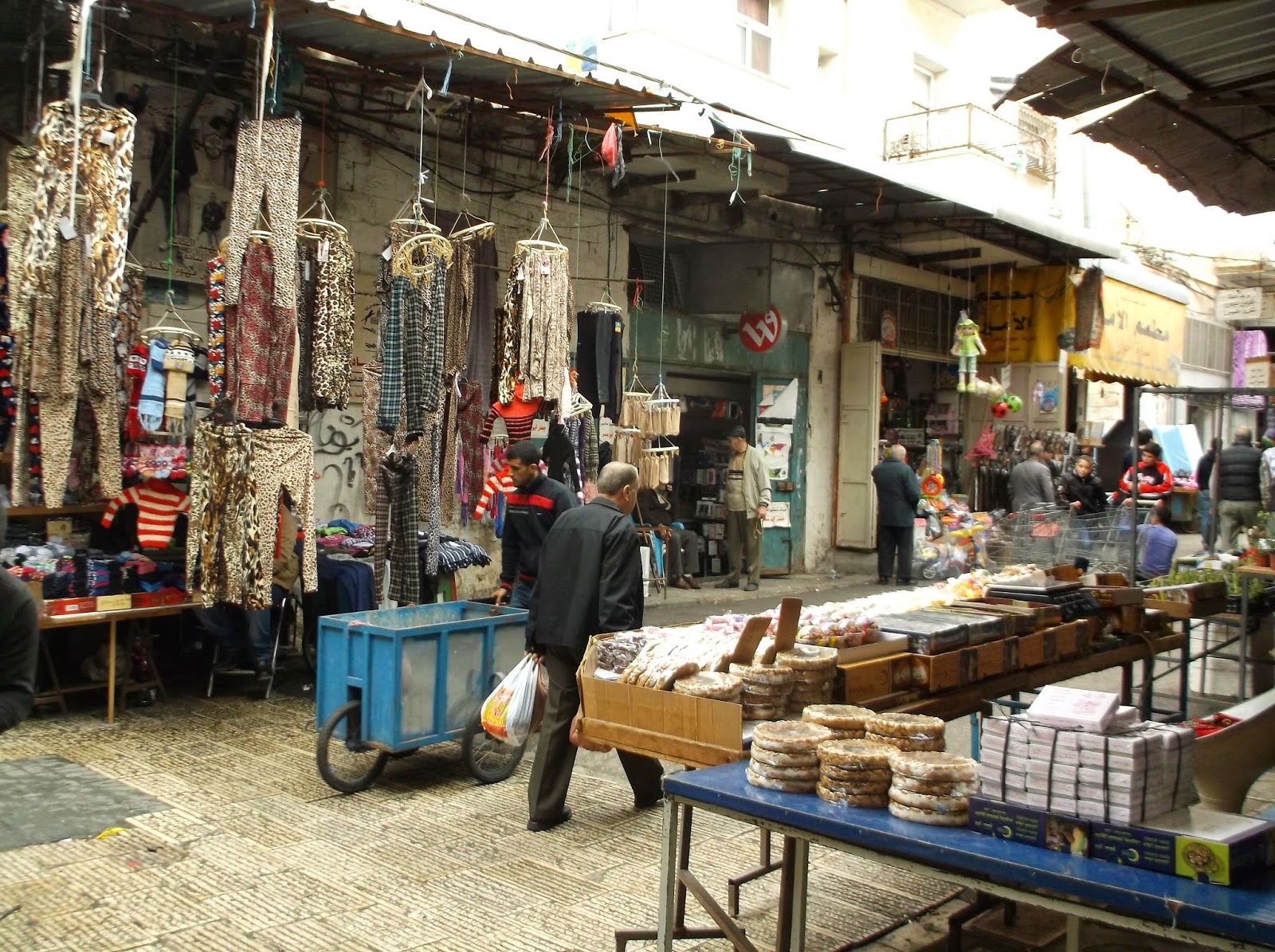
This gave us time to catch up on writing and to look around the beautiful city of Nablus.  Built by the Romans after they destroyed the existing town, the old city is very beautiful and picturesque.  Shops are in small arched alcoves. Road ways are arched over with buildings.  All forms of produce are exchanged in open air markets often protected by tarps hung across the road. Cars thread narrow road ways.
the street we walk every day

stairs to a friends appartment
vacant lots are a window to wonderful old construction


 just typical views of the old city


many of the streets of the old city are full of market by day


10.31.2014

31 Oct 14


31 Oct 14
The troubles that surrounded the closing of the Al Asqa mosque (which President Abbas called it a declaration of war and which complicate relations with Jordan because the Mosque and East Jerusalem are acknowledged as under Jordanian rule) were the back ground for today’s demonstrations.  A Zionist activist who has been advocating demolishing Al Asqa Mosque (the third most holy site in Islam) and building a Jewish temple in its place was shot presumably by an Arab.  But the Israeli military later killed a suspect rather than arresting him (wounding him and then killing him at close range before allow an ambulance in), leaving people wondering if they were just using the incident as a chance to target someone they wanted to get rid of.  There were planned and unplanned demonstrations in most villages. We went to Qalandiya, a city west of Ramallah. The apartheid wall goes through town and the check point there has been the site of a weekly demonstrations protesting the building of the wall.

The week had been full of many other incidents such as, a Palestinian youth hospitalised by a settler hit-and-run, Israeli forces raided numerous home and took captives in many towns in the West Bank, 10 or so new orders for house demolitions, settlers destroy the traditional communal bread ovens in several villages.

Everyone waited with bated breath on all sides and around the world wondering what would happen.  Some hoped for retribution for Israel's evident attacks on the world accept status quo of the Al Alsqa mosque. Some hoped unrest would give a justification to further efforts to make Jerusalem a more purely Jewish city. Some needed to express their anger, while others were wrapped in fear.


The trip to Qalandiya was uneventful though there were obviously more soldiers on the streets. After prayers youth marched with flags and a banner down the street toward the check point which is still smoke stained from earlier clashes between soldiers and demonstrators. The soldiers fired a half dozen salvoes (typically 24 canisters) of tear gas and use rubber coated steel bullets. The demonstrators set tires on fire and threw rocks at the soldiers by hand and with sling shots. The weather joined in with bouts of heavy rain. In the end the rain seemed to gets its way as the demonstration lost energy on all sides.  But not before the Israeli fused some controversial .22 LR calibre fire. This is fired by snipers designed to take out the legs of demonstrators. Its use would be another violation of Israel's own rules now that a Judge Advocate ruled that it could no longer be classified as non-lethal (after it was used to kill a number of demonstrators).


clouds of teargas

tires to set on fire 

Olive Harvest

 On Monday October 27, 2014, the MPT team participated in the olive harvest with a family living in Burin, a village in the Nablus region. The village lies in the valley between two illegal settlements on the surrounding hillsides: Bracha and Itshar.  Burin has been frequently targeted by settlers in these illegal communities, in forms such as physical attacks on villagers, attacks on villager’s houses and property, and attempted destruction of olive trees.  Additionally, a main road used by both settlers from nearby illegal settlements and Palestinians lays in the middle of the village’s olive fields, presenting an easy opportunity for car passengers to stop and cause trouble.  The Israeli occupation forces have also recently put up road blocks on the main road into Burin, making transportation to and from the village difficult, if not impossible. 
 
 
The MPT team picked with a very generous and welcoming family of three. The mother, Ramid, and father, Mohammed, are parents of six children; however, only one of the children, Amer, age 12, was able to pick with his parents on this day.  The team helped the family harvest the olives from 8 trees. 

Working hard throughout the day, we took many welcome breaks at the behest of our hosts.  We took tea in the morning (shay, in Arabic), which was a sweet mint tea that helped keep us going.  Later, the team was generously invited to share the midday meal with the family, and in true form of Arab hospitality, we were encouraged to eat until we could eat no more.  The afternoon was broken up with Arabic coffee (oawa, in Arabic) to give us a boost for the rest of the workday.
 
MPT teamers can play a variety of roles when accompanying farmers during the olive harvest.  Sometimes farmers have experienced trouble from the Israeli occupation forces, who attempt to prevent them from harvesting their olives.  Other times, settlers from nearby illegal settlement cities harass farmers, attempt to destroy their olive trees, or even attack the farmers themselves.  In these instances, MPT teams can serve as intermediaries, to attempt to de-escalate any potential violent situations and protect the farmers from harm or arrest.   In other instances, farmers living in risky areas may be wary of harvesting without any international presence, even if they haven’t had any recent trouble.  This was the case with the family in Burin today. 
 
 The day was thankfully quite quiet and the team did not encounter any trouble. Throughout the day, two Israeli occupation force jeeps drove by, and three F16s circled the village (and wider Nablus area) continuously, flying at the speed of sound and making a lot of noise with each pass. While the MPT team noted this every time, the family was quite used to the flying jets overhead and took no notice.  They continued to work diligently, trying to finish as many trees as possible as the harvest season is drawing to a close.  


10.29.2014

28 Oct 14

Today we picked olives in Burin, a short "service" ride south of Nablus. We have picked in the area quite a lot because illegal settlements (Bracha and Yitzar) have been established on the hills on both sides of the valley and the only road from one of them comes right into Burin. The couple we picked with today was quite young, were nice and, took good care of their olive orchard.

a stop for tea

an nicely open pruned tree, Burin behind, settlement on hill top

Taking care of orchards is hard. The harvesting time is not set by the ripeness of the olives, it is determined by the time window the Israeli military sets for harvesting. After an illegal settlement is established the occupation force sets up a buffer area around it in which farmers are not allowed in their fields without a permit from the Israeli military. During harvest there is s general permit, but to prune the orchard requires a special permit, as does being in the till (all the orchards are tilled every year) and, to fertilize the orchard.


This couple did a lot of pruning during picking. I am not sure if this the right time to prune, but that may be how they get it done – prune during the harvest permit time. While picking we found a large wolf spider, 2-3 inches, her back was covered with all of her young. At first, before close inspection, it looked like hair on her back. There was also a large green caterpillar, probably one of the Saturniidae, over 3 inches long.  
a variety at lunch

cleaning up the prunings from the orchard

the spider

10.26.2014

On Sunday, October 26, the MPT team attended the funeral for Orwa Hammad, the fourteen year old US citizen who was fatally shot by the Israeli military last week. Over a thousand people (mostly men) came out in the village of Silwad to mourn his death.  All the shops were closed in honor of him and cars and buildings were covered with posters honoring him.  
 The funeral had to be postponed until Sunday so his father could arrive from Louisiana and his mother from Jordan. Walking with the precession which filled parallel streets we met the parents of other children who were recent victims of Israeli shoot to kill actions which are in violation of their own rules of engagement.  An unsubstantiated statement by the Israeli military says young Orwa was preparing to throw a Molotov cocktail; multiple eye witnesses disagree. 
After the burial 50 to 100 boys returned to the site of the shooting. As black smoke rose from tires the Israeli military fired large quantities of tear gas, about 4-5 salvos of 20 tear gas grenades each.  They also fired two different types of rubber coated bullets at the boys.  Four ambulances we used to take the injured to medical care.
During the first tear gas attack a neighbor opened their door to get us in out of the tear gas. They gave us wipes for our burning skin and eyes.  They brought out a tray of refreshments for us, but we took advantage of a lull in the tear gas to make a break-for-it to put more distance between us and the soldiers.  As we thanked them for their hospitality they express their appreciation for us being there in solidarity with them.
While we watched from where the gas was less we were left worrying about our new friends.  Not only has the Israeli military occupied the edge of the village near their house but after and hour of gas attacks their house must be filling with it. It must be hard having such an awful and momentous event as the killing of child happen outside you house. It is likely to be a place of contention for a long time.


10.21.2014

MPT Fall Olive Harvest Team Arrives Safely; Please Watch for Reports from the Field!

Thank you for your support of Meta Peace Team and our wonderful Fall Olive Harvest (and beyond) International Peace Team to the West Bank.

We are pleased to share that the team has arrived safely.

Please watch for reports of their work from the field, as well as photography, right here on the MPT Palestine team blog.

Thanks again for all your support -- time, talent, and treasure -- your participation in this team is what makes it possible for folks to deploy.

Sincerely,

Nicole, Martha, and the MPT Staff and Volunteers
Meta Peace Team