*NEW* Search Our Team Reports! Type a word/phrase in the box below (hint: try "settlers').

10.25.2012

PSCC - Boycott Israeli Goods - Action Report


Earlier today the team participated in a nonviolent direct action coordinated by the Palestinian led Popular Struggle Coordination Committee (PSCC). A group of eighty internationals, Israelis, and Palestinians also took part in the action. The group entered an Israeli owned Rami Levi supermarket south of Ramallah and proceeded to chant slogans and carry banners reading "Boycott the Occupation and its Products." Upon leaving the supermarket, demonstrators were forcibly denied access to the nearby highway by approximately forty Israeli soldiers, police, and border police. The peaceful protest was met with violence as Israeli authorities fired sound grenades into the crowd and aggressively attempted to arrest demonstrators. Two Palestinian activists and two internationals were detained and arrested, including one MPT team member*. Two Palestinians were injured and evacuated from the scene by ambulance. Of the two injuries, one resulted from a man losing consciousness following the detonation of a sound bomb in his vicinity. The other occurred after an elderly Palestinian man was robbed of his walking stick and physically assaulted by security personnel. 


*More details about team members arrest cannot be released at this time for security reasons.


Rami Levi supermarket, near Israeli settlement, where activists demonstrated to “Boycott the Occupation and its Products.”

Protestors march away from Rami Levi supermarket toward the wall of forty Israeli soldiers. 

Soldiers force a physically-challenged elderly Palestinian man to the ground, while taking away his cane.

Israeli soldiers disgracefully shove elderly Palestinian man to the pavement.

International protestors scramble to pull a Palestinian activist away from potential arrest

Palestinian activist handcuffed and taken to secure area for detainment and later arrest. 

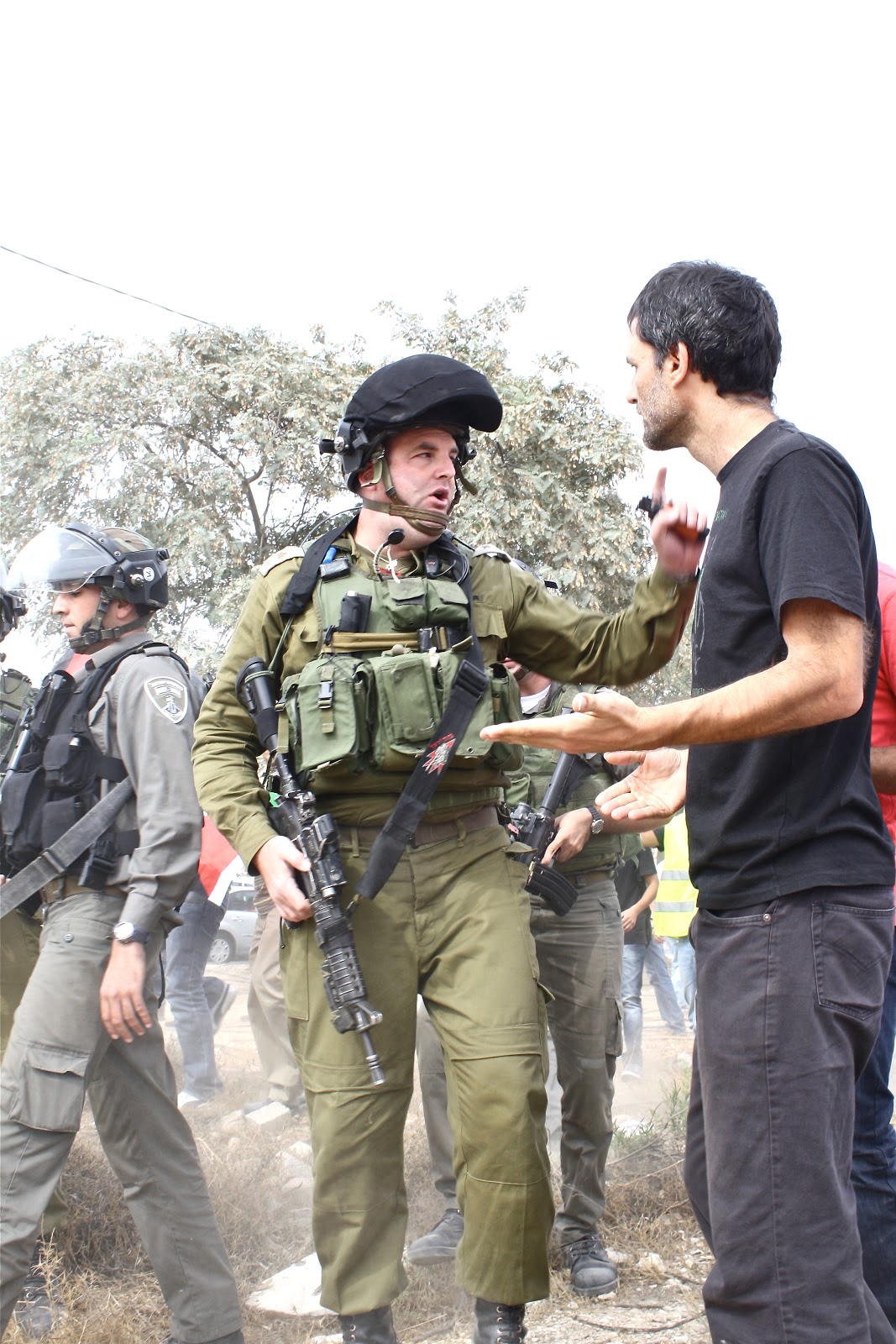
Israeli soldier confronts a non-violent Palestinian activist

Protestor is made unconscious by sound grenade thrown at his feet, fellow activists work to revive him. 

By John & Sam

10.23.2012

Getting to know the neighborhood


        The 2012 Fall Team came together on Oct. 11 when Sam, John, and Katrina arrived to join Tom and Mary who had arrived a few days earlier.  On our first evening together we were contacted by the field coordinator for Rabbis for Human Rights and asked if we could join a group of folks coming up from Jerusalem to pick olives in a field very close to our location.  It was feared that there could be trouble from an ultra-orthodox settlement nearby.  Despite some travel weariness, the Team decided to respond affirmatively to the request.  We are glad we did. (See our blog posted by Katrina on Oct. 16.) 
The Fall Team... Mary, Tom, John, Sam and "Dorothy" :)

On Sunday we decide to take a short trip north to the city of Nablus (pop.134,000). There we visit the Balata Refugee Camp which began as a tent city in 1950 when Zionists took over villages that are now part of Israel.  With United Nations help it now consists of permanent structures.  It is the largest refugee camp in the West Bank with 20,000 residents and is plagued by overcrowding and unemployment.  Adjacent to the Camp is the site of Jacob’s Well where Jesus met the Samaritan woman and revealed himself to her.  It is now the site of an Orthodox church which had its beginnings in 529 A.D.
The bazaar in Nablus

In the center of Nablus, we visit the famous Al Qasaba, a bazaar that goes as far back, they say, as 4000 years.  The name, Nablus, goes back to 70 A.D. when the Romans built a new city and named it Neapolis.  Today Nablus is known for its strong resistance to the Israeli occupation.  For that it has become known as The Radical City.  In 2002 a major battle took place in which there were 78 deaths, hundreds were arrested, and 64 buildings damaged or destroyed.  The UN estimated the damage at $110 m. (Wikipedia)
Jacob's Well
Balata Refugee Camp
In the Al Qasaba bazaar we visit an olive-oil soap factory deep within the labyrinth of shops and stands.  We talk at length with an older man who explains how olive-oil soap is made.   When we ask him how he feels about his city being under occupation, we are surprised by his calm reply.  We have been here for centuries, he says, and there may be times when enemies try to take our homes away, but we will still be here and in the end we will prevail, inshallah (God willing), and, if not in our time, we will still go in peace to heaven with God.

His words remind us of a poem that one of our Team shared the next day.
 It is called “Palestinian Am I” by Edna Yaghi: Here are the last two verses…
No one can take my identity
Away from me,
Not tanks or guns or bombs
Meant to desecrate me and kill me.
My country lives in me.

I am the cry of liberty
No matter what they take from me,
They can’t take away my identity
Or my dignity.
Palestinian am I.

To read the poem in its entirety, go to:  www.mediamonitors.net/edna9.html


By Tom & Mary


10.16.2012

Come closer. Letters from the Holy Land*


* Yes, the Holy Land, exactly. Whole Land. The Holy Earth with all her
never ending patience, beauty, variety and ability to survive, surprise and be reborn, .


You who stand on our doorstep, come in
and drink with us Arabic coffee
[you might feel you are humans like us].
You who stand on our doorstep
get out of our mornings
so we can be certain
we are humans like you.

Mahoud Darwish
(Bio on the side:
Mahoud Darwish was born in 1941 in Birwa near Acre. He died in 2008. He had been actively involved in the cultural dimension of the PLO. As a poet, Darwish was both deeply personal and political. His personal love poems fuse with the political in the most extraordinary way.
Darwish was known throughout the Arab world as 'the poet of Palestinian resistance.', said Wikipedia)

Message from Tel Aviv
On the way to Palestine, we spent a night in Tel Aviv. Famous Sin City welcomed us with open arms with all its vibes, electricity, dizziness, colorful people looking straight in your eyes. Everyone who I talk to seems to be open-minded, friendly and well-educated. Ofir, our Israeli host, leaves us, perfect strangers, keys to his house and is giving me a good hug before we hit the road.

Message from the dawn
First morning in Palestine I am waking up with a muezzin (a chosen person at a mosque who call the prayer) and I am taking a dawn walk. The little white, dusty street is totally quiet, the town is slowly opening its eyes. I meet a cheerful girl who laughs to me and waves after me till I am completely gone. Two little boys invite me to their house. A few awake people shine when they see me and greet me. I am going to the mosque and it is so peaceful. The air smells like a delightful mixture of thyme, olives and some unidentified purple flowers. I can’t believe that in this paradise there is a fight going on.

Message from the soccer
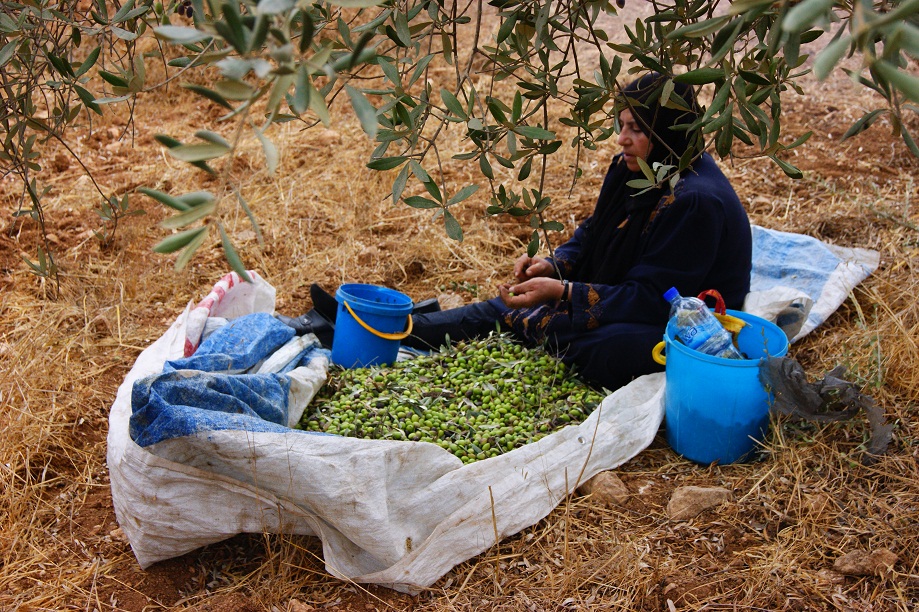
Our very first day we go to harvest olives with a group of internationals among others many Israeli activists called by Rabbis for Human Rights. What’s the story about picking the olives? It does not sound like a serious peace mission, does it? Well, the thing is that for ages Palestinians used to take care of the trees (some of them are thousands of years old!), often it might be the only income for the family, from generation to generation they would produce olive oil and soap. Then the Israeli settlers came and forbade them from getting to their gardens. They would harass them, break their trees and shoot. That’s why part of our job here is to assist the families working in their fields to make it safer.
Palestinian woman selecting the olives, quality controller. 


During the lunch prepared by women from the family in the shadow of the trees we talk about conflict solutions.
 How about soccer for peace?:

Watch the video!


Boys school in Nablus.

They took five kids from each side and they gave them a ball. 5 year old children played soccer happily without thinking about the colors of their flags.
Children older than 10 years already had a problem: they would send a colleague first – you go, I’ll see if it is safe. After first recognition they would play together cheerfully.


Where is the link between these stories?

Message from Noam
In the bus going to West Bank from Jerusalem the Rabbis for Human Rights crew met this Israeli girl who asked them where they were going.
- To help some Palestinians pick the olives, they said.
- Are you crazy?! They will kill you!, she was absolutely frightened.
- You see, that’s the thing, explains Noam, film maker, journalist for social tv, we live in one land, but we don’t know each other. Most Israelis had contact with Palestinians only while in army service when they had to have a gun ready to point in ‘enemies’ direction. If your government gives you a weapon and a certain way of thinking, it's easist to believe Palestinians are bad people. Or rather – that they are not people at all.

Olives harvesting. Palestinian boy helping Israeli activist to wash his hands.


Message from Gabi
We meet an Israeli girl writing pro-Palestinian articles for a right wing paper (!). She says:  don’t get trapped. Do not come here just to help them, do not see them only as victims, try to embrace the whole picture. They cry and laugh, love and hate, play and fight; there is every day life going on, in all its cruelty and beauty.

Katrina,
MPT

10.14.2012

On our way to Palestine!

Anchors Away! Observations and impressions on our way to Palestine

 We’re settled in on a Boeing 777 leaving Newark, NJ arriving Tel Aviv Ben Gurion at 8:25A the next day. Our seatmate is a young man who introduces himself as Alex. He’s maybe 22 years old, rather tall, swarthy, unshaven, lived in Russia as a child. Why are you going to Israel, we ask. I’m going on the Birthright program, he tells us. Birthright- which is primarily funded by Jewish philanthropists - allows persons of Jewish descent to go to Israel for ten days, free of charge, to tour the country. It will help him decide if he wants to move there. If he does, the Israeli government will help finance his move to the settlement of his choice in the West Bank. An effective way to grow the country – and promote a sense of connection between Israel and members of the Jewish Diaspora.

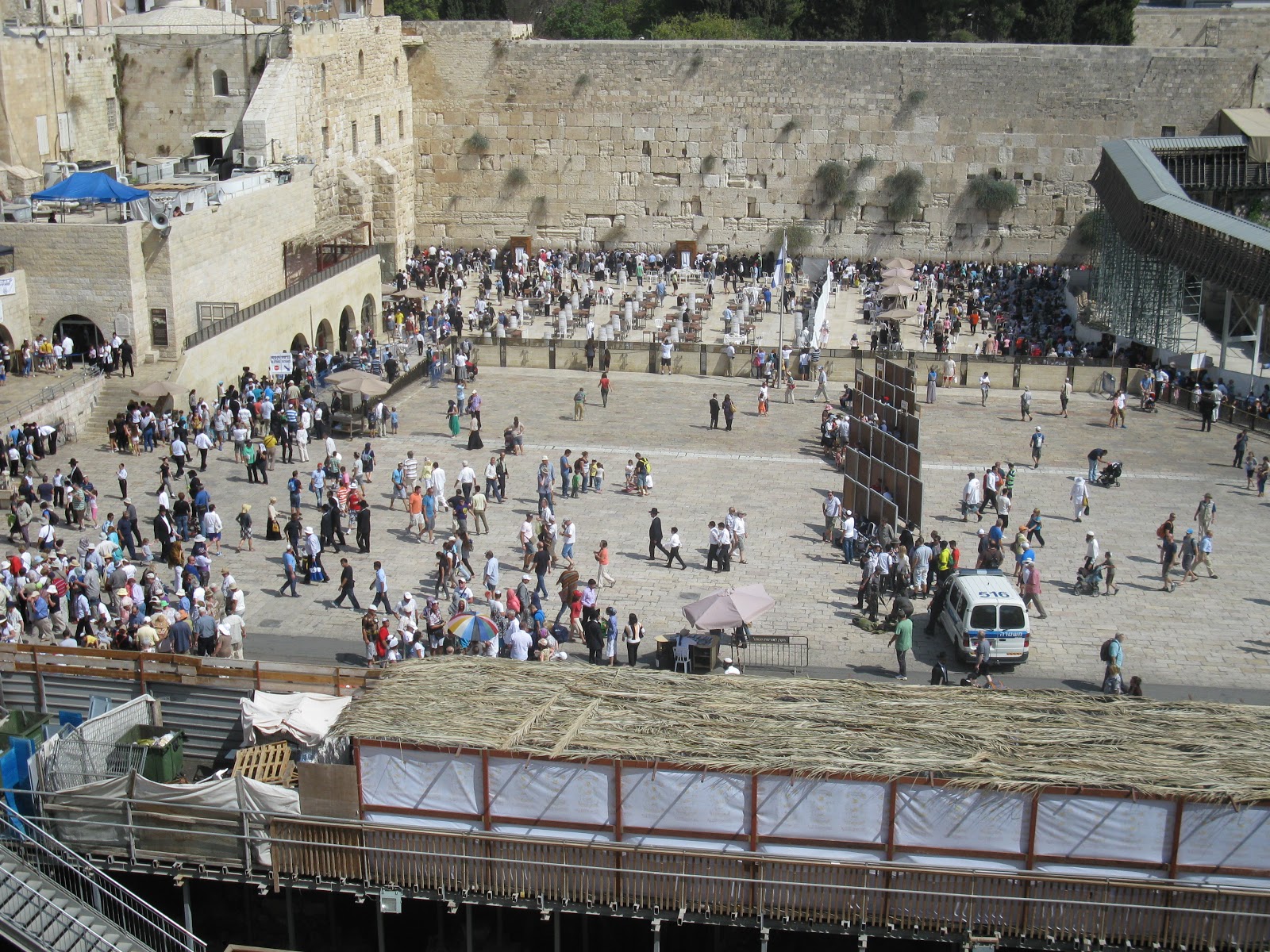
Faithful Jews praying at the Western Wall
 We’re arriving in Jerusalem after a long wait at the airport for a shuttle bus. Traffic is extremely heavy.  We see many tour buses lined up in parking lots. Israel’s new tramway, which opened last year, is jammed with people. Making slow progress on Jaffa Road leading to the Old City, we come to an intersection blocked by a police car. Our driver argues with the policeman to allow him to go through. No luck. Passengers going to the Old City’s Damascus Gate have to exit the bus. Five minute walk, he says. After a half hour walk in the midday sun, pulling our suitcases, we arrive at our destination. We have arrived in Jerusalem at the beginning of the Jewish Festival called Sukkot. It is observed in memory of the 40 years the Israelites spent in the wilderness after the Exodus. There are thousands of Jewish faithful in the city for five days. Jerusalem means everything to everybody in Israel/Palestine.

93 year old woman, displaced from her home

 We hear about a bus tour leaving from a local hotel called a “Political Tour.” We join a group of 25 students from Denmark and four tourists from Germany. Our guide is about 47, dark curly hair. He says he can pass for an Italian—and sometimes does. He tells us he has spent a total of nine years in Israeli prisons over the years. We go to East Jerusalem which was assigned to the Palestinians after the Six Day War in 1967. We see a large Jewish settlement, built with permission of the Israeli government, complete with a Separation Wall snaking between Palestinian and Jewish homes. We drive north through the massive checkpoint on Nablus Rd and make our way back to a section of East Jerusalem , called Sheik Jarrah, to visit an old woman (93). Some years ago a Jewish family from Brooklyn came to East Jerusalem. They claimed they bought the title to the house, which was issued many years ago during the time when the Ottoman Empire was in control, from owners who live in Turkey. Their claim was upheld by the Israeli Court. The old woman was forcibly evicted from her home by the police. However, she refuses to give up her home or leave her neighborhood. She lives on the street in front of her former house. That’s life in Palestine!

Written by Tom and Mary

10.10.2012

MPT Fall 2012 Palestine/Israel Peace Team Arrives Safely

The Fall Team 2012 members have all arrived safely in country and cleared customs.  Thanks to all the home support persons and MPT volunteers and staff working to support this team in the field!

Please watch for blogs in the next few days with updates about the team, and then direct reports of their work in the field.

This team has been working hard for months on skills building, team building, fundraising and awareness work -- as well as other preparations for their team.  We look forward to sharing the stories of their work and those they meet in the field this Fall/early winter.

Please keep reading and watch for updates.

Nicole
MPT