Jordan River Valley
Our first team excursion was a trip to the Jordan River Valley. Forming the eastern border of the Occupied Palestine Territories (OPT), the valley is the lowest land area on earth at 380 meters below sea level and comprising almost 30% of the West Bank, from the Sea of Galilee to the Dead Sea. Because of this depression, a natural greenhouse is formed that makes the Valley a wonderful agricultural area, in a desert. It might be compared to a smaller version of the Central Valley in California. The Jordan River Valley, with over 80 historical and cultural sites, rich mineral deposits near the Dead Sea and a pleasant climate, is second only to Jerusalem as a tourist destination.
Palestinians here find their view of reality much different from either the tourist or the Israeli settlers. Those living here experience an awful sense of isolation, cut off from their relatives, their land, adequate services such as water or electricity, personal safety, a sustainable economy to provide for basic needs, and a basic sense of human dignity.
Their situation of extreme isolation has far more than a psychological impact. Systematic isolation was reinforced when the Oslo Accord of 1993 divided the Jordan River Valley into three areas. Zone A is under Palestinian Civil and Security control but is only 3.5% of the total Valley and has only two Palestinian villages. Zone B was intended to be a joint effort of management by both Israel and Palestine, but in reality is Israeli controlled. It has five Palestinian villages and accounts for another 2% in area. Zone C is under total control of the Israelis and the illegal Israeli settlements. That is another 50% of the Valley. The remainder of the land, more than 40%, is closed to the very Palestinians living in the valley. This remaining land is used for military bases, nature reserves, and border areas.
The most visible source of isolation for the people is the apartheid wall that the Israel government is winding, in no defensible path, through the West Bank. This illegal wall separates Palestinians from Palestinians and Palestinians from Israelis. In 2003, Prime Minister Ariel Sharon announced additional “Eastern Segregation” wall within the OPT to further isolate the people. In 2004 the International Court of Justice found the structures illegal. This did not deter the Israeli Government. Instead, on June 12, 2006 Israel announced a status change to the land of the Jordan River Valley, further isolating the area from the West Bank. It was also dropped from final status negotiations and military procedures escalated. It is an obvious land grab of a beautiful and production part of the country.
Approaching the valley, one is confronted by large watch towers, military guards armed and dressed in green fatigues and a formidable checkpoint. As we were questioned and our passports scrutinized there was an aura of a prison. The regular curfews imposed without explanation, impeding movement, is like a prison lockdown. We were entering a huge, open-aired prison. The Palestinian people are living in the isolation we reserve for criminals.
 Illegal Israeli fences crisscross the land
Warning sign of illegal electrified fence
Trenches and fences with razor wire, some electrified, crisscross the landscape, separating people from their land, therefore their livelihood. Thousands of dunums [dunum = ¼ acre] of pasture land are closed. So people whose families have been grazing their animals for at least 2000 years are prevented their normal access.
We picked up our guide at a second checkpoint. Our guide translated the story of two agitated Bedouin men who had just crossed the checkpoint.

Our guide conversing with Bedouins
September 8, 2008, Israeli soldiers confiscated two large water tanks which these Bedouins used for drinking and watering the animals. The army gave them papers documenting the confiscation. They were assessed 11,000 shekels (about $3,200 in the U.S) for the return of the tanks. They didn’t have the money to redeem the tanks so the fine continues to increase. We photographed the papers and had the guide authenticate them.

Documentation of the water tank theft
These tanks are their only source of water, since their wells had been confiscated previously. They have been without these water tanks for 15 days and were growing desperate.
The Bedouins were told there was sufficient funding from OCHA, the United Nations Office for the Coordination of Humanitarian Affairs, to supply water tanks to several Bedouin encampments, but the Bedouins of the area wanted this large amount of money spent for a pipeline to be built bringing water into arid areas. Replacing water tanks would solve the immediate problem, but a long term solution is needed.

Woman whose home was demolished.
We met the young woman who was an activist in her area. She stood near the pile of sun-dried bricks she made from straw and mud. Although Israeli soldiers had demolished her home and out buildings, she was determined to rebuild. She would not leave her ancestral land. We stood in the wreckage of her possessions and were struck that she had lost much but retained her patience, spirit, hope, and commitment to the land.

Labor intensive mud bricks.
According to OCHA in area C of the Jordan River Valley, in 2007 alone Israel authorities “demolished 90 dwellings and 101 other buildings, the majority of which were for lack of building permits.” (Food and Agriculture Organization, January 23, 2008)

Foundation of demolished home.
The Palestinians around the village of Fasayel built a five room school out of the type of sun-dried bricks we had seen. The first effort was destroyed by a strong wind. They persisted and built a second time. It was destroyed by a heavy rain. The third time they were able to include some concrete and the building stands to educate 70 children from grades 1 through 5.

Third try - new school.
The school has no plumbing, electricity, or running water. The children drink from a large tank in the yard.

Thirsty child drinking from outdoor tank.
While visiting the area, Tony Blair was presented with the problem of the two failed attempts and the possible demolition of the third school. Being under complete Israeli control, it could be demolished at any time because of its position in zone C Blair was so impressed with the dedication of the local people that he negotiated with the Israeli government to allow the school to function for the children. It took pressure from outside the country to secure a basic right for these children.
 Happy students in the new classroom
The joy of recess
From the school, we traveled to meet the mayor of Bedhat , the pictured small village straddling areas B and C. No one is exactly sure of the borders because the Palestinians do not have access to the maps. His family had been expelled from Tel Aviv in 1948 and settled in the Jordan River Valley. He was disgusted with the waste he witnessed from the work of the non-governmental organizations, NGO’s, in his area. One group had $100,000 and four years of work that produced only “research, studies, lavish parties” and nothing tangible for the people. He was expecting an announcement the next day that the girls’ school that had been planned for the area would not be funded after all by the Japanese government. Both he and our Palestinian accompanier were harshly critical of NGOs. His most definitive and resolute comment was that his family had been expelled from their home once and they would never go through that again – never.
Leaving Bedhat, we passed a large, modern packing plant built of white concrete blocks and with electricity to provide refrigeration. We could not stop and take photos because security people would prevent us. This was for the use of the illegal settlers that have been placed in the Valley. The three small settlements built in 1968 have grown to 36 settlements today. According to MA’AN Development Center, any Israeli willing to settle in the valley is given a free house, a 75% discount on electricity, utility, communication and transportation. They are provided with free education, health care, and irrigation water. The settlers are offered 70 dunums of land and a $20,000 long-term loan along with a multiplicity of other benefits. More information on these advantages can be found at www.Btselem.org/English/Publications/summaries/200205_Land_Grab.asp

Illegal Israel greenhouses dot this land
We viewed these rows of greenhouses used by the illegal settlers, while across the road the Palestinians were struggling to manage crops in rocky soil with little access to irrigation.

From arid to verdant – unsustainable water use.
We visited with a Palestinian date farmer at his packing plant - a caravan of corrugated iron, set up on concrete blocks. This makes it possible for him to move it, rather than have it demolished by the army. There is no electricity, inadequate water and, of course, no refrigeration possible.

Palestinian packing plant.
He was a proud and capable man whose family had once owned a large farm with much water. Today he is reduced to farming a small parcel of date trees with his one or two remaining wells. When asked about his access to irrigation, he proudly told of his wells and how the crops were irrigated. He was concerned that the settlers used their sewage to irrigate crops and he knew from his experience that this was not a proper method. He felt this could pose a health hazard.
Because trade restrictions have been imposed so farmers cannot leave the Valley to sell their produce from normal outlets, people who once traded with other Arab countries in the region and could access ports on the Mediterranean are confined to local villages in the Jordan River Valley. While the United States demands free trade for its products, it also supports a government that denies that right to the Palestinians. There are six permanent checkpoints and hundreds of “flying checkpoints” that appear without warning, stopping traffic and slowing the movement of any produce.

Palestine produce truck detained at Israeli checkpoint.
The dates that our host would harvest, and the products of other Palestinian farmers in the valley, end up being marketed to Israelis because of their inability to freely reach markets. These same factors make the Palestinians reliant on Israel for seeds, fertilizer, tools and other essentials to sustain their land.
Both the United States and the United Nations consider these settlements in the West Bank as illegal. In the Guardian, on July 6, 2008, Paul Gallagher reported on Agrexco, a large Israeli exporter that regularly buys food grown on confiscated Palestinian land and then labels it a product of Israel. (www.guardian.co.uk) The British have been aware of this injustice and are boycotting these goods taken from stolen lands. The livelihood and well being of people is diminished by a deception in labeling. Brand names such as Carmel, Jaffa, and Coral are part of Agrexco, but in the United States it is difficult to determine which are legitimate Israeli products and which are produced on confiscated land. Since the FDA does not provide this information a boycott of all Israeli products must be considered. Making occupation profitable to the occupiers will prolong the injustice.
 Bedouin tent and arbor.
Electric power lines, but power unavailable to Palestinians
The last visit was with a Bedouin family living in tents under electric lines and over water pipes, but without access to electricity or water. An OCHA report in January of 2008 explains the effects of the drought in the area on the herders who depend on rainwater for domestic drinking and water for flocks. They also count on rainwater for the growth of vegetation on grazing land and crops for their own use and animal fodder. [OCHA, FAO report January 23, 2008 on Drought]

Bedouin animals are also endangered.
The Israeli authorities have forbidden Palestinians from using the Jordan River. They have destroyed or isolated 162 irrigation projects east of Road 90, the main road running along the valley, in the last forty years. Israel controls the positions of the wells, how deep they can dig, and how much water can be pumped. Untreated settlement water often seeps into Palestinian artesian wells and springs. The Palestinians are not allowed to construct sewage systems. The drought combined with these other restrictions, and others, imposed by Israeli authorities make it almost impossible for the Bedouin families to preserve their age-old way of life. (FAO January 23, 208)
It seems ironic that we have lists of endangered animals and yet there is no effort made to save an endangered people. We defend anyone’s choice of lifestyle in the United States and ignore the simple, chosen lifestyle of these people. Dignity, access to water, electricity, ability to sustain life by herding animals, freedom to move around the land that is theirs - these are not exorbitant requests.
The Jordan River Valley has two contradictory planning schemes. The Israeli settlers, motivated by profit, have an economic agenda. The Palestinians are trying to preserve a way of life and continue using their own land, to farm, herd, and try to live a reasonable life. These divisions have caused desertification and soil erosion. The indigenous Palestinian people have no sovereignty over their land and natural resources. They have been denied the right to manage the land over a contiguous area and cannot maintain the natural ecosystem without these abilities. A disproportionate amount of the natural resources and arable land has been allotted to the Israeli settlements that are illegally present. Some would say that the illegality should prohibit them from any of the resources.
While the settlers swim in pools, and live in tile or brick roofed homes built without harmony to the land, the Palestinians live in homes with flat roofs to collect rainwater and achieve a more organic extension of the land. The fragile environment in the Jordan Valley has been the first casualty. Barren areas have replaced once fertile land. The Jordan River is more polluted and brackish than ever. The Dead Sea has sunk so low that it is now two separate seas and still getting lower according to a study by the Applied Research Institute of Jerusalem, 2207. The carrying capacity of the land is unable to support the reality we saw in the Jordan River Valley.

Bedouin boy with the family flock at sunset.
This could be an area of great agricultural production. This could be a vital tourist destination with historical and archaeological interest. This could be a model of eco-tourism that would draw more interest than Costa Rica. The minerals and salts of the Dead Sea could provide luxury spa destinations. None of this is viable within the present structure. The Palestinians and the Israelis are loosing and the earth itself is loosing.


 Higher up and overlooking the farmer’s land is the illegal Israeli settlement from which settlers come to harass him and his family.
 The family arrived within minutes with necessary supplies and everyone got to work.
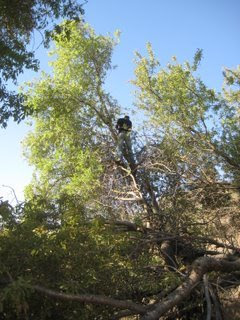
 The boys of the family climbed up into the trees to knock the almonds down with sticks. Everyone else picked up the almonds that fell to the ground as well as what they could reach on the lower branches.